The Price of a Protocol
An AI harness rests on protocols somebody already settled. Knowledge work has none, and settling them costs twice: in labour, and in authority handed over.
If you work in an office, the odds are reasonable that you installed something this year which reads your meetings, or drafts the first pass at a document, or turns a folder of notes into a brief. Possibly several things. They worked well enough that you kept them, and you stopped thinking about it.
What you were doing, without especially deciding to, was assembling. The people who build software have a word for the assembled thing: a harness. It is everything wrapped around the AI model to make it useful for actual work. Which instructions it carries. Which files it can see. Which tools it is allowed to reach for. The points where it stops and asks you rather than proceeding on its own. The model underneath is roughly the same one everybody else has. The harness is the part that makes it yours, and it is where all the interesting differences live.
Among the people who build these for a living, the advice has converged this year, and the most credible voices give it hardest: stop waiting for a product. Yours is going to be specific to you. Build it.
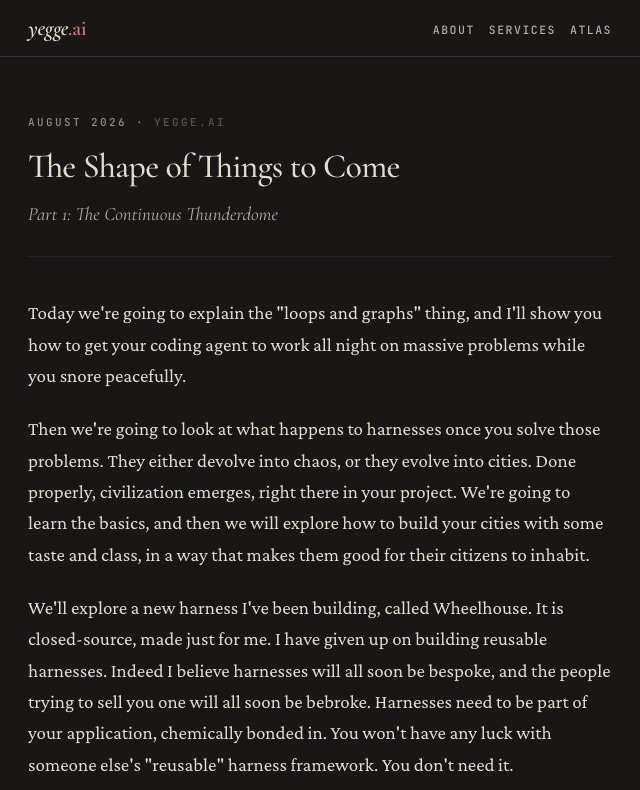
Steve Yegge, who has spent three decades writing about how software actually gets made, put it about as bluntly as it can be put a few days ago, describing the system he had built for himself:
“I have given up on building reusable harnesses. Indeed I believe harnesses will all soon be bespoke, and the people trying to sell you one will all soon be bebroke.”
He’s right, and if you are assembling your own version of this you have probably already felt why.
He is also not talking about knowledge work. He is describing coding harnesses, for people who write code, and inside that world the claim holds completely. What makes it useful out here is what happens when you try to carry it across the border.
A bespoke harness is affordable because it sits on a layer nobody negotiates.
Yegge can assemble whatever he likes, his own tools in his own sequence under his own conventions, precisely because he will never once have to establish what a change is, what it means for two versions to reconcile, or whether a test that passes counts as passing. Those questions are settled. Their being settled is what buys the freedom above them. The bespokeness lives in the assembly.
Look at what git actually does, since it’s the floor under most of this. It came out of a licence dispute in 2005: the Linux kernel lost access to the commercial tool it had been keeping its source code in, and Torvalds wrote a replacement in a fortnight because the alternative was a project of several thousand volunteers losing the ability to work together.
What that fortnight produced was a set of absolute settlements about mechanics. What a change is. How it is recorded, attributed and undone. How two versions reconcile when they disagree. A commit means the same thing at a bank and at a games studio, and two engineers who have never met can read each other’s history without first agreeing what history is.
It settles nothing whatsoever about policy. How much belongs in a single change, and when to split one into several. When to branch. What a good message says. How much review is enough, how much testing is enough, when shipping something imperfect beats holding it back. Every team fights about all of it, every team lands somewhere different, and no team has to relitigate what a commit is in order to have the argument.
That combination is the thing being missed. Git is not an example of bespoke tooling. It is the non-negotiable floor that makes bespoke tooling cheap.

Susan Leigh Star spent a career on why that floor is so hard to see. Her argument, in a 1999 paper on the ethnography of infrastructure, is that infrastructure is partly defined by going unnoticed: it is the layer people stop seeing precisely because it works, and it tends to become visible only when it fails. Which is why almost nobody in the current conversation credits git with what it is doing. Nobody credits the plumbing either, until the water stops.
There is a reason for that absence, and it isn’t neglect. Marc Andreessen’s line about software eating the world, from 2011, described software rewriting one industry after another into code: retail, logistics, media, finance. What made each of those possible was that somebody could specify the process precisely enough to encode it. Software ate what could be specified.
The parts of knowledge work it ate are the specifiable ones. Scheduling. Expense approval. Document storage. The CRM nobody loves. What it left alone is everything nobody could write down: judgment, taste, the reason one option was taken over another, what counts as enough evidence to say something.
That leftover is not a gap software forgot about. It is the residue of forty years of eating, and it is exactly the layer now being asked to specify itself.
Which is why the advice does not transplant cleanly into knowledge work.
Told to build a bespoke harness for knowledge work, a practice is being asked to do two jobs that look like one from outside. Assemble the tools. And negotiate the substrate they sit on. The first is a weekend and a set of preferences. The second is what law spent several centuries on, under pressure from courts, and what the internet’s standards bodies still do full-time.
There is no shared store where a piece of strategy work is recorded, attributed and reversible. There is no unit of change smaller than a whole document, which is why the last version of anything is called final_v7_FINAL. There is no agreed vocabulary for what a claim, a finding or a client actually is, so no two firms mean the same thing by any of them. Bespoke all the way down is what having no standards looks like from the inside.
And it produces a specific exhaustion, which is where I keep landing when I try to make the case for doing this work.
A team sits down and establishes what a report means for them, definitionally, so the work can be handed to a machine. It takes a month and it is genuinely useful. Then the client turns out to have different ideas about what a report is. Then the next client has others. Nobody in that story did anything wrong and the returns are still diminishing, because the team was made to invent something that should never have been theirs to invent.
Some of what a protocol contains could be settled once, somewhere else, by people who are not you. What a meeting summary must contain. What a research finding has to carry before anyone can rely on it. What has to be attached to a claim for it to be attributable later. Nothing about those is a fact about your firm, and every firm currently derives them privately, sometimes badly, in the dark.
Some of it can never be settled anywhere but in your own room. Which of two available mistakes you would rather make. Who decides when the rules run out and the situation is genuinely new. Those are facts about what your practice values and who holds authority in it, and any standard claiming to supply them would just be describing somebody else’s firm.
The exhausting part of this work right now is that everybody is doing the first job in order to reach the second. The first job is infrastructure and it is being done as craft, ten thousand times over, by people who wanted to get on with something else.
It would be easy to end here by calling for a committee. I don’t think that’s the interesting part, and I’m not sure I want one.
Because the thing already exists somewhere, and it’s worth looking at what it cost.
A scientific paper has a shape. An abstract, a description of method, results, a discussion, references in a form somebody else’s software can read without being told. Nobody submitting to a journal argues about whether the method section is required. That took a few hundred years to settle and it works, in the sense that a chemist in Osaka can read a paper from Utrecht without a preliminary conversation about what a paper is.
It also cost something, and scientists have been complaining about the cost for as long as the form has existed. Null results don’t fit the shape. Neither does a long inconclusive argument, or the real sequence in which a discovery happened, which is almost never the sequence the paper describes. The form quietly decided what kind of knowledge was easy to publish, and the fields adapted to the form rather than the other way round.
That’s the actual trade, and it’s the one on offer.
Keep the right to define what a good meeting summary is for your practice, and pay for it in definitional work that never ends and doesn’t transfer anywhere. Or take somebody else’s definition, get the floor for nothing, and give up the standing to say your version was better.
Nobody is going to make that choice on behalf of a strategy team, and no amount of tooling decides it. It is a question about what a profession thinks it is.
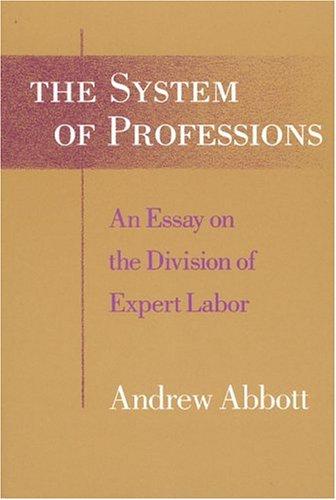
Andrew Abbott’s account of how professions actually work is useful and slightly brutal. In The System of Professions, published in 1988, he describes occupations as competing for jurisdiction, meaning control over an area of work, and argues that the decisive contests are fought on grounds of competence and theory rather than over the work itself. What a profession holds is the definition. The doing is downstream of it.
Which makes handing the definition to somebody outside the room a jurisdictional surrender wearing the clothes of an efficiency gain. The people who know what good looks like are usually the people whose standing rests on being the ones who know, and a settled standard takes that from them without giving anything comparable back.
Which is the tension knowledge work has with all of this, visible in one small object. Every time the machinery improves, somebody is asked to write down the thing that made them worth asking in the first place.
There is a version where the trade is plainly worth taking, and it turns on what the floor is for.
Everyone repeating that AI adoption is eighty percent not about the technology is correct, and almost nobody says what the eighty percent consists of. This is what it consists of. Not change management, not training days, not the choice between a subscription and an API. Agreeing what the things are called and what has to be inside them. Unglamorous, slow, and the precondition for everything that comes after.
It also gives a name to something that has been going without one. Organisations announce AI programmes, transformation initiatives, centres of excellence, and none of those phrases points at an object. The object is a harness: the assembled thing a practice actually works through, made of tools, instructions, access, and the places where a person still decides. Implementing AI in an organisation, done in a way that changes anything, is building one.
Which is why so many programmes produce a great deal of activity and no difference in what the organisation can do. They buy the capability and never touch the definitions, so they end up with half a harness: a practice that can now generate far more, faster, with no more agreement than it had before about what any of it should contain.
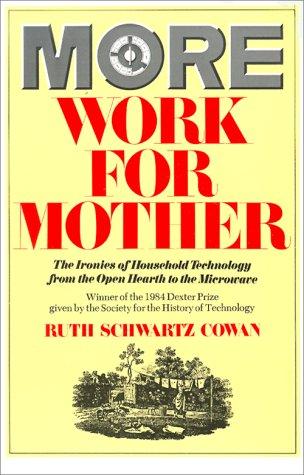
It stops being a treadmill at the point where the agreement lets a practice do something it could not do before. Ruth Schwartz Cowan’s argument about household technology was that the machines never reduced the labour, because the standard rose to meet them and the work reorganised around what had become possible. A settled floor behaves the same way. Nobody standardises the meeting summary in order to keep having the same meeting summaries. You settle it so the effort moves somewhere it was not previously affordable, and the outputs worth having sit well above anything a standard would reach.
So the distinctiveness relocates rather than disappearing. A practice stops being identifiable by the shape of its meeting notes, which was never much of a distinction, and starts being identifiable by what it can build once the notes have stopped being a question.
I made the case for this in January: strategy itself should become a protocol, explicit enough to be read by people and run by machines. I would still make it. What I didn’t have then was an honest account of the price, and this is the price. The thing being handed over is real, and the people asked to hand it over are the ones with most to lose by doing so.
Which is why I don’t think the answer is obviously yes. The choice is about where in the stack your thinking is allowed to show, and that is a different question from whether it gets to show at all.