Contact Lenses for a Headband
Agents collapsed the cost of joining data: a half-broken EEG headband experiment, and why noisy sensors now make every archive worth more.
A few weeks ago I put in contact lenses for the first time in twenty-five years, and the reason wasn’t vanity but hardware compatibility. I’ve been experimenting with a consumer EEG headband as part of a client project on neural interfaces, and it turns out these devices don’t get along with the chunky Jacques Marie Mage frames I wear every day — the sensors sit more or less exactly where the acetate does. So for a few weeks, on the days the experiment ran, I blinked my way through my meetings (I had forgotten how much I dislike touching my own eyeball) so that a band of electrodes could watch my brain while I worked.
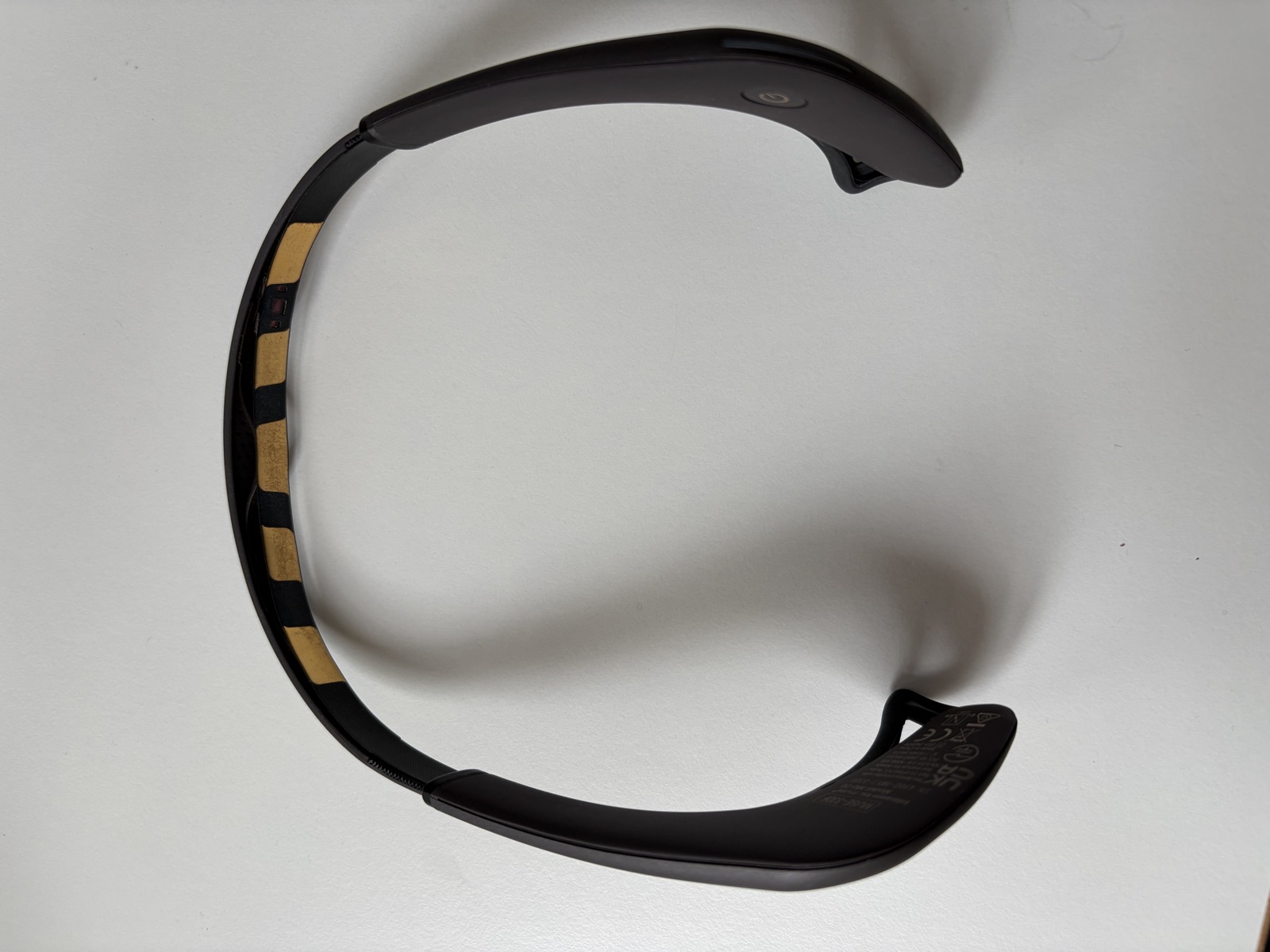
What it feeds into is a system I already had. Every meeting I have gets transcribed and summarized into my notes, and for the duration of the experiment the headband added a brain-state section to each summary — cognitive load, drowsiness, frontal alpha asymmetry. The people I met during those weeks got annotated too: a colleague’s entry in my notes carries a small string of metrics recording how my mind responded to them, meeting by meeting. Consumer EEG is famously noisy, and not every session recorded; some summaries just read, “No EEG data available for this meeting’s time range.”
The part I keep thinking about is how little this cost. I’m not a developer, and until very recently connecting a consumer sensor to a note-taking system would have been weeks of engineering that nobody could justify. I built it in an afternoon, with an agent doing the wiring. The opportunity was just sitting there, waiting for someone to know which questions to ask.
I’ve written before about Ruth Schwartz Cowan and the dishwasher (More Work for Mother): efficiency is the boring part of any new technology, and the more interesting question is what complexity it lets you afford. The dishwasher didn’t just clean plates faster, it made the small-plate restaurant economically viable. What agents have made affordable is something specific. It isn’t collecting data, and it isn’t storing it. Storage has been cheap for twenty years, which is how we ended up with data lakes nobody could actually use. What collapsed is the cost of joining data to other data.
And joining is where the value was hiding all along. The EEG stream on its own is noise, a number wobbling around a baseline. Joined to the meeting transcript, it becomes an observation — my attention dropped during the budget discussion. Joined to the people in my notes, it becomes a longitudinal record of how my mind behaves around specific people, across years. The same noisy data turns into three very different things depending on what it can connect to, and the layers doing the multiplying already existed. The compounding runs backwards into the archive.
This also inverts the oldest problem in brain-computer interfaces. The field has spent decades assuming that useful neural data requires better sensors — more channels, better contact, eventually implants. It’s the “enhance” scene from every police procedural, the belief that the answer lives in higher resolution. But a language model doesn’t enhance; it needs the data to have neighbors. There’s a wave of devices coming that will record things about us that were never recordable before — Apple holds patents for earbuds with EEG sensors built in — and all of them will produce noisy, ambiguous signals, and that will matter much less than it used to.
I’m aware of what I’ve built here, which is part of why it stayed a contained experiment — a few weeks, a handful of meetings, and a headband that now spends most of its time in a drawer. Still, my notes contain things about a few other people — how my brain responded to them — that they never gave me and don’t know exist.
I started with the obvious question, which was what a brain sensor could tell me, and the honest answer so far is: not much on its own. The question that survived the experiment is a different one, and it isn’t about brain data or my notes. Everything you’ve been keeping (meeting transcripts, support tickets, the CRM nobody loves) was collected back when joining it to anything was expensive, so nobody ever asked what else it could become. That’s the question worth asking now: not what AI can do, but what your archive becomes the moment something new can join it. Every archive turns out to be one cheap join away from being a different thing than the one you thought you were keeping.